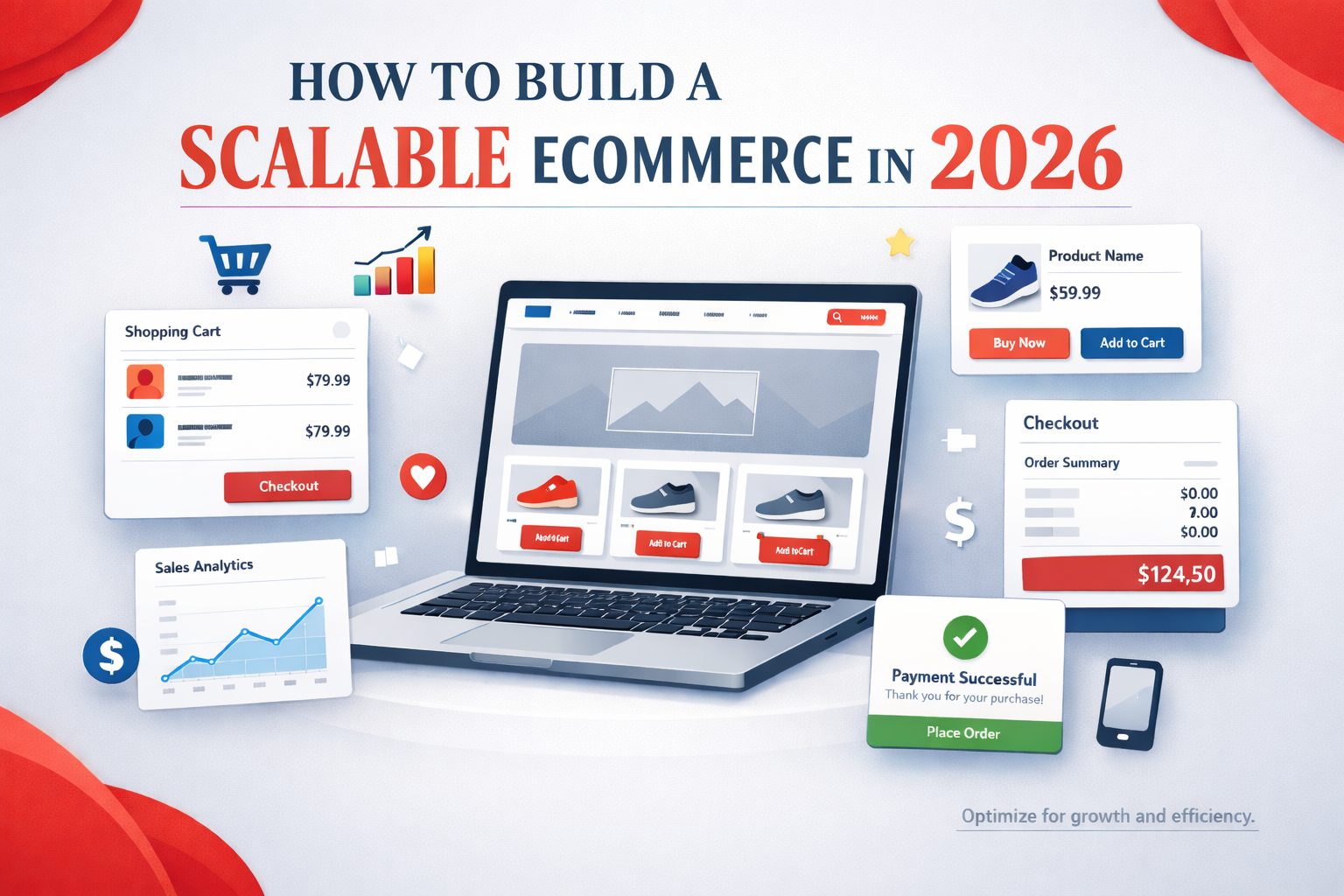
In 2026, launching an ecommerce store is not impressive anymore.
What is impressive is building one that survives growth.
Picture this.
You launch your brand. Ads are working. Influencers are posting. Traffic jumps from 300 visitors a day to 20,000 overnight.
And then your website crashes…
That is not a marketing problem. That is a scalability problem.
Most ecommerce founders focus on design first, ads second, and infrastructure last. But the brands that dominate in 2026 do the opposite. They build foundations that are ready for growth before growth even comes.
Let’s walk through how to build an ecommerce website that does not panic when success arrives.
🧠 Think Beyond “Launching”
A scalable ecommerce website is not just about handling more traffic.
It is about handling:
-
10x product uploads without slowing down
-
5x traffic spikes without crashing
-
Global customers without currency confusion
-
1000+ orders a day without backend chaos
Scalability means your website grows quietly in the background while you focus on marketing and expansion.
🏗️ Start With the Right Platform
Your platform choice is not technical. It is strategic.
If you choose wrong, you rebuild in two years.
🛍️ Shopify for Serious Growth
Shopify remains one of the most stable ecommerce platforms in 2026. It handles hosting, security, performance, and scaling automatically.
When your traffic spikes, it adjusts.
When your orders increase, it manages load.
For brands that want predictable growth without server stress, Shopify is a strong foundation.
🎨 Framer for Premium Brand Experiences
Framer is powerful when you want high converting landing pages and storytelling driven ecommerce funnels.
If your brand positioning matters as much as your product, Framer helps you build fast, visually premium experiences that convert attention into action.
🌐 WordPress for Content Heavy Stores
WordPress with ecommerce integrations can work well, especially for SEO focused brands. But scaling requires proper optimization, hosting upgrades, and technical management.
The rule is simple.
Choose a platform that grows with you, not one that demands rebuilding when you succeed.
⚡ Speed Is Revenue
In 2026, speed decides trust.
If your product page loads in 4 seconds, customers doubt you.
If it loads in under 2 seconds, customers explore.
Speed directly impacts:
-
Conversion rate
-
Google rankings
-
Bounce rate
-
Ad performance
To build a scalable ecommerce website, optimize from day one:
-
Compress images properly
-
Avoid heavy animations
-
Use performance optimized themes
-
Limit unnecessary plugins or apps
-
Enable caching and CDN
Speed is not a technical feature. It is a sales multiplier.
🎯 Design for Conversion, Not Compliments
Many founders want a website that “looks cool.”
But scalable ecommerce is built around psychology.
Ask yourself:
-
Is the call to action visible instantly?
-
Is checkout friction minimal?
-
Is mobile experience smooth?
-
Is trust visible within 5 seconds?
In 2026, mobile traffic dominates ecommerce. If your mobile layout feels cluttered, slow, or confusing, growth stops quietly.
A scalable design removes confusion and shortens the path to purchase.
🔎 SEO Is Not Optional Anymore
Paid ads are powerful. But they are rented attention.
SEO is owned traffic.
From the beginning, structure your website properly:
-
Clean URLs
-
Keyword optimized category pages
-
Internal linking
-
Schema markup
-
Fast indexing
-
Optimized product descriptions
When organic traffic compounds, your ecommerce store scales without depending entirely on ad budgets.
Smart brands build SEO into the architecture, not as an afterthought.
📦 Prepare for Virality Before It Happens
The worst time to think about scalability is during a viral moment.
Your infrastructure must already support:
-
High traffic concurrency
-
Secure payment processing
-
Fast checkout under load
-
Real time inventory updates
If you plan for 500 visitors but receive 50,000, your website should not break.
Growth should feel boring on the backend. That is real scalability.
🤖 Automation Is Silent Scaling
Manual processes kill growth.
A scalable ecommerce system automates:
-
Email sequences
-
Abandoned cart reminders
-
Order confirmations
-
Inventory tracking
-
CRM updates
-
Customer segmentation
Automation allows you to handle 10x orders without 10x employees.
That is how brands expand profitably.
📊 Measure What Actually Matters
Scaling is data driven.
Track:
-
Conversion rate
-
Average order value
-
Customer acquisition cost
-
Lifetime value
-
Repeat purchase rate
Test continuously. Improve product pages. Simplify checkout. Refine offers.
A scalable ecommerce website is never “finished.” It evolves.
🌍 Build With the Future in Mind
2026 ecommerce is global by default.
Your website should be ready for:
-
Multi currency pricing
-
International shipping
-
Language flexibility
-
AI driven recommendations
-
Personalization
Even if you start small, your infrastructure should support global ambition.
🏁 The Real Difference Between Stores That Scale and Stores That Stall
The difference is not luck.
It is preparation.
One founder launches quickly without planning infrastructure.
Another founder builds a strong foundation first.
When growth comes, one celebrates. The other scrambles.
Scalability is not expensive. Rebuilding is.
💼 Ready to Build a Store That Grows Without Limits?
If you want a scalable, high performance ecommerce website built the right way, Qubesys is ready to help.
We are a Dubai based web design and development company established in 2008, specializing in:
-
Framer based premium websites and landing pages
-
Shopify store design and development
-
Conversion focused ecommerce architecture
-
Performance optimized scalable builds
Visit www.qubesys.com and let’s build an ecommerce system that grows as fast as your ambition.
Subscribe To Receive The Latest Updates
We talk about tech only
Add notice about your Privacy Policy here.